Why Classroom Management Training Alone Won’t Fix Your School
Classroom management systems determine whether your school runs smoothly or spirals into chaos. However, most principals approach this challenge backwards. They focus on individual teacher performance instead of building-wide consistency.
When I walk into struggling schools, the pattern repeats itself. First-year teachers receive generic classroom management training. Meanwhile, veteran teachers operate with completely different expectations. As a result, students navigate conflicting rules every period.
This fragmented approach creates what we call Discipline Drift — the gradual erosion of consistent expectations that destroys school culture.
How Broken Classroom Management Systems Start
Picture this scenario: Ms. Rodriguez teaches math in room 204. She requires students to raise hands before speaking. Next door, Mr. Jackson encourages open discussion without hand-raising. Furthermore, down the hall, Mrs. Chen uses a complex point system for participation.
Students bounce between these rooms every fifty minutes. Consequently, they struggle to predict what behavior works where. This confusion doesn’t indicate bad teachers — it reveals a systems problem.
Most schools never design their classroom management systems. Instead, they let individual teachers create their own approaches. Therefore, consistency becomes impossible.
The Real Cost of Inconsistent Management Systems
Inconsistent classroom management systems damage more than daily instruction. They create cascading problems throughout your building. For example, office referrals spike because teachers lack clear intervention protocols.
Additionally, parent complaints increase when families can’t understand shifting expectations. Meanwhile, new teachers burn out faster without systematic support structures.
Consider Jackson Elementary’s transformation. Before implementing systematic classroom management, they recorded 51 suspensions annually. However, after establishing consistent procedures across all classrooms, suspensions dropped to just 1 per year.
This dramatic improvement didn’t happen through teacher training workshops. Instead, it resulted from engineering predictable systems building-wide.
Building Effective Classroom Management Infrastructure
Effective classroom management systems require intentional design before the first student arrives. Most importantly, every classroom needs identical foundational structures while allowing teacher personality to shine through.
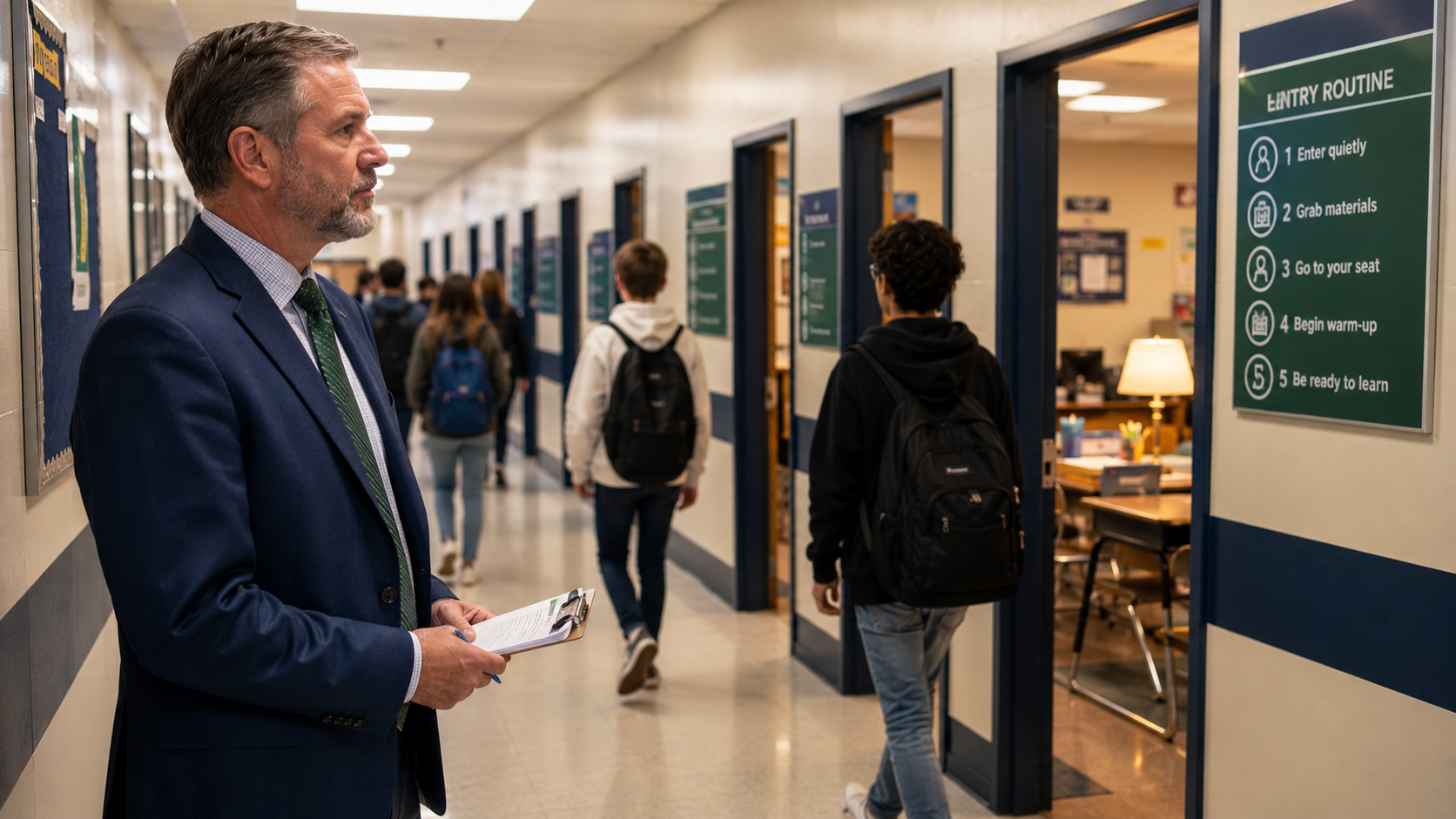
Start with universal procedures that every teacher implements exactly the same way. For instance, design identical entry routines for all classrooms. When students enter any room, they know exactly what to do.
Next, create standard transition protocols. Whether moving from discussion to independent work, every classroom should follow the same process. Consequently, students develop automatic responses that reduce instructional time loss.
Furthermore, establish consistent attention signals across all spaces. When teachers need student focus, the method should be identical whether students are in math class or the cafeteria.
The Principal’s Role in Classroom Management Success
Building principals own the design of classroom management systems. However, many leaders delegate this responsibility to individual teachers. This approach guarantees inconsistency.
Effective principals engineer what we call the 4 Pillars of Discipline Stability. These pillars include clear expectations, consistent consequences, predictable routines, and systematic follow-through. When these elements align across all classrooms, behavior problems decrease dramatically.
For example, East Central High School struggled with 604 office referrals annually. After their principal implemented systematic classroom management protocols, referrals dropped to 84. Meanwhile, their graduation rate climbed from 52 to 77 percent.
This transformation required the principal to stop hoping for consistency and start engineering it.
Designing Your Classroom Management System Framework
Begin by mapping your current reality. Visit every classroom during the first week of school. Document the procedures students encounter in each space. Most likely, you’ll discover dozens of conflicting approaches.
Then, identify the five most critical procedures every classroom needs. These might include entry routines, attention signals, movement protocols, material distribution, and assignment submission processes.
Next, design these procedures collaboratively with your teacher leaders. However, once designed, implementation must be non-negotiable across all classrooms. This isn’t about controlling teachers — it’s about creating predictability for students.
Additionally, build systematic observation protocols to ensure consistency. Regular walkthroughs should focus on procedure implementation, not personality differences between teachers.
Moving Beyond Quick Fixes to Lasting Systems
Many principals attempt to fix classroom management through reactive measures. They purchase new discipline programs or mandate additional training sessions. Unfortunately, these approaches treat symptoms rather than root causes.
Lasting improvement requires what we call the 3-System Breakdown: prevention systems, intervention systems, and restoration systems. Each component must align across all classrooms to create building-wide consistency.
Prevention systems include the predictable routines students can count on. Intervention systems provide identical responses when students struggle. Finally, restoration systems help students rebuild relationships and rejoin the learning community.
Consider reviewing our comprehensive approach to building discipline systems that last for additional implementation strategies.
Research from the Institute of Education Sciences confirms that schools with systematic approaches to classroom management see significant improvements in both behavior and academic outcomes. Their longitudinal studies show consistent implementation matters more than individual teacher charisma.
Remember this fundamental truth: predictable environments produce predictable behavior. When you engineer consistency across classrooms, you create the conditions where all students can succeed.
Your classroom management systems either work for every student or they work for none. The choice between chaos and clarity starts with your leadership decision to design rather than hope.