You Lost the Room — Here’s How to Get It Back
Your assistant principal has handed you the new referral system three times this year. Meanwhile, the numbers haven’t moved. You announced the discipline system at the faculty meeting. You trained the staff during pre-planning. You sent the follow-up email, held the debrief session, and maybe even laminated the flowchart for every hallway. However, every Monday morning still looks exactly the same.
That is not a people problem. That is a structure problem.
Why Your Discipline System Exists on Paper Only
There is a fundamental difference between telling people what to do and building an environment where the right thing happens automatically. One approach relies on memory, motivation, and goodwill. The other relies on engineering. Schools that drift into chaos did not lack good intentions. They lacked designed systems.
Announcing a discipline system is not the same as building one. A real system has checkpoints, feedback loops, and built-in accountability that does not depend on anyone remembering to follow up. When those elements are missing, the system exists on paper and nowhere else. Therefore, referrals still pile up. Teachers still feel unsupported. Students still game the inconsistencies.
This is what we call Discipline Drift at EDCO. It happens when your structure slowly erodes because no one is monitoring whether the system is actually being used. As a result, your building returns to default mode: whoever yells loudest gets the response.
What a Real Discipline System Looks Like in Practice
Consider what happens in most schools when a teacher submits a referral. The referral goes into a database. Someone reads it eventually. A consequence gets assigned based on who handled it and what mood they were in that day. The teacher rarely hears back. The student returns to class without a clear message about what changed.
Now compare that to an engineered discipline system. First, the referral triggers an automatic notification to the assigned administrator within 15 minutes. Next, that administrator has a 24-hour response window that gets tracked on a dashboard the principal reviews every morning. Then, the teacher receives a follow-up confirmation once the consequence is delivered. Finally, the student and parent both sign a reentry contract before the student returns to that classroom.
One version relies on people doing the right thing when they remember. The other version makes forgetting impossible. Furthermore, one system drifts. The other system holds.
The 4 Pillars That Keep Your Discipline System From Collapsing
EDCO has worked with more than 2,352 schools over 40 years. In building after building, we have watched referral counts drop from hundreds per semester to single digits. However, that change did not happen because teachers suddenly became better classroom managers overnight. It happened because the structure around them changed first.
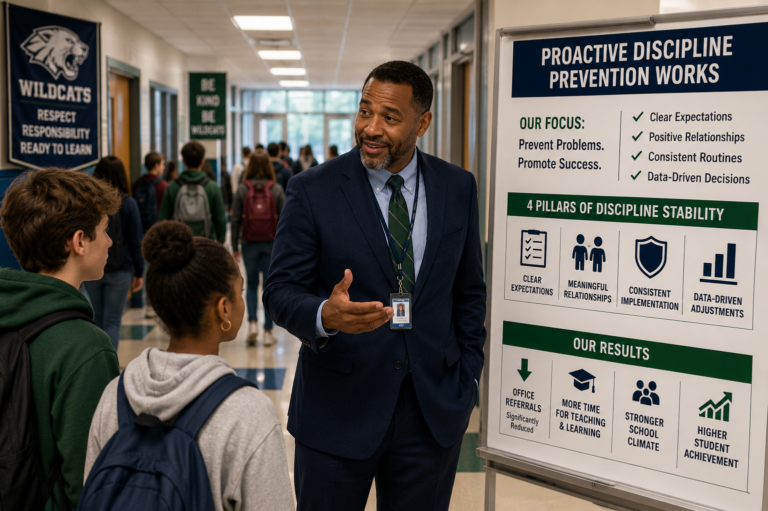
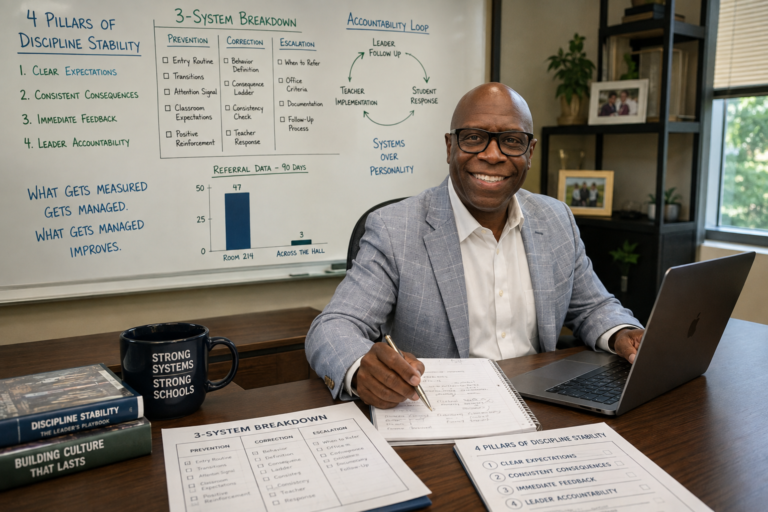
Predictable behavior is the product of predictable systems. Engineers build predictable systems. Leaders do too. At EDCO, we call this the 4 Pillars of Discipline Stability: clear expectations, consistent consequences, documented accountability, and leadership follow-through. When any one pillar weakens, the entire structure leans. When two pillars fail, the system collapses.
Most schools lose the room because they built only one pillar. They wrote the expectations. Then they assumed the rest would follow naturally. It never does. Because systems do not self-sustain without engineering.
How One Texas District Engineered a 99% Referral Reduction
Rio Hondo ISD came to EDCO with a discipline system that existed entirely in the handbook. Teachers were frustrated. Parents were confused. Students were bouncing between classrooms and consequences with no clear pattern. The district did not need new rules. They needed an Accountability Loop.
We built checkpoints into their referral process. Every referral required a response timestamp. Every consequence required a documentation form. Every administrator reviewed their dashboard daily with the principal. As a result, referrals dropped 99 percent within one semester. Not because students changed. Because the system finally worked the way it was supposed to.
Jackson Elementary followed a similar path. They entered the year with 51 suspensions in the fall semester. By spring, they had one. East Central High School reduced suspensions from 604 to 84 in a single year while raising their graduation rate from 52 percent to 77 percent. None of those schools hired new staff. They re-engineered the structure.
Stop Announcing and Start Engineering Your Discipline System
If your discipline system is not producing the results you expected, the problem is not your people. The problem is your structure. You cannot announce your way into accountability. You have to design it into the process so tightly that skipping a step becomes harder than following through.
This is where most schools stall. They know something is broken. However, they keep trying to fix it with another email, another meeting, or another motivational speech. Meanwhile, the structure underneath stays exactly the same. Therefore, nothing changes.
The free Discipline Strategy Session at EDCO is built to show you exactly where your structure has drifted. You will walk away with a clear map of what is missing and what needs to be rebuilt. No pitch. Just a plan.
One Question Every Principal Should Answer This Week
Walk your building right now and ask yourself: where does my discipline system exist in name only? Is it the referral process? Is it the follow-up loop? Is it the reentry protocol? Most importantly, is it the leadership accountability structure that should be monitoring all of it?
Whatever you identify, that is where you start engineering. Because losing the room does not mean your staff stopped caring. It means your system stopped working. Fix the structure, and the room comes back.
Ready to fix your school’s discipline system?
Schedule a free 30-minute Discipline Strategy Session with Dr. Thomas Glanton. No pitch — just a clear plan for your school.